
On November 27, 1895, Alfred Nobel signed a will in Paris that devoted most of his fortune to annual prizes for achievements of exceptional value to humanity
He specified five fields: physics, chemistry, physiology or medicine, literature, and peace. The bequest brought scientific achievement, literary work, and international politics into a single system, underwritten by a fortune Nobel had made from explosives
The first prizes were awarded in 1901. More than a century later, the Nobel name has become a widely recognized marker of distinction across fields that otherwise have little in common
The system behind the name is less unified — and less fixed — than it appears

From a will to an institution
Nobel’s death in 1896 left instructions rather than a functioning prize system. His will was controversial, his assets were distributed across several countries, and relatives challenged parts of the arrangement
Much of the practical work fell to the two executors he had named, Ragnar Sohlman and Rudolf Lilljequist. They spent several years consolidating assets, resolving legal disputes, and building the structure needed to carry out Nobel’s wishes
The Nobel Foundation was formally established in 1900 to manage the endowment and administer the prizes. It does not select the laureates; separate institutions do:
- physics, chemistry, and the later prize in economic sciences — the Royal Swedish Academy of Sciences
- physiology or medicine — the Nobel Assembly at Karolinska Institutet
- literature — the Swedish Academy
- peace — the Norwegian Nobel Committee
The Nobel system is therefore a network of separate bodies rather than a single jury deciding every prize
Nominations, secrecy, and fixed rules
Candidates cannot nominate themselves. Each prize has its own pool of eligible nominators, including selected academics, members of academies, previous laureates, parliamentarians, and other qualified figures
A Nobel nomination means only that an eligible nominator submitted a candidate’s name; it does not indicate endorsement or shortlisting by the committee
Information about nominees, nominators, and internal deliberations remains confidential for 50 years
Awards can be shared by no more than three individuals. Organizations are eligible only for the Peace Prize
If no candidate meets the required standard, a prize can be withheld until the following year rather than awarded on schedule. Several prizes went unawarded during the two world wars
Since 1974, Nobel Prizes have generally not been awarded posthumously. A prize remains valid if a laureate dies after the announcement
The rule produced an unusual case in 2011. The Nobel Assembly announced that Ralph Steinman would share the prize in physiology or medicine for his work on dendritic cells. Soon afterward, the Assembly learned that he had died three days earlier
Because the decision had been made without knowledge of his death, the award was allowed to stand
Laureates can refuse a prize without losing their place in the official record. Boris Pasternak initially accepted the 1958 Literature Prize before declining under Soviet pressure. Jean-Paul Sartre refused the 1964 prize because he rejected official honors
Nobel decisions are final. There is no formal appeal process, and prizes are not revoked if subsequent generations reassess a laureate or the work that received the award
Why scientific prizes often arrive late
Nobel’s will used the phrase “preceding year”, suggesting that the prizes should recognize recent work
Scientific research rarely fits such a timetable. Results that initially appear transformative can fail replication, while apparently narrow findings may later reshape an entire field. Years of verification and adoption may pass before a discovery’s importance becomes clear
In 2024, John Hopfield and Geoffrey Hinton received the Nobel Prize in Physics for foundational work on artificial neural networks dating back to the 1980s. The award illustrated both the decades that can separate research from recognition and the increasingly blurred boundaries between physics and computer science
The scale of modern science creates another mismatch with Nobel’s rules. Major discoveries in particle physics, astronomy, and genomics can involve hundreds or thousands of researchers, while a scientific Nobel Prize can name no more than three individuals
The restriction was easier to reconcile with the organization of science in the early twentieth century than with collaborations on the scale of CERN and similar projects. The Peace Prize can recognize an organization; scientific prizes cannot be awarded to a laboratory, experiment, or research consortium
The limit also shapes public memory, compressing vast collaborative achievements into a handful of names
What the literature prize recognizes
Nobel’s will referred to the person who had produced the most outstanding literary work “in an ideal direction,” a formulation broad enough to accommodate very different readings over time
The Swedish Academy may recognize a writer’s broader body of work instead of a particular book. Asking which single book earned an author the Nobel Prize can misrepresent how the award is decided
The prize has never been restricted to fiction, drama, or traditional poetry. The Nobel Foundation’s statutes also recognize other writings whose form and style give them literary value
The Academy honored Bertrand Russell in 1950 for writings defending humanitarian ideals and freedom of thought, and Winston Churchill in 1953 for his historical and biographical work as well as his oratory. In 2016, the prize went to Bob Dylan for creating new poetic expressions within the American song tradition
The wording of Nobel’s will has remained fixed; its interpretation has changed considerably
What the Peace Prize recognizes
Nobel’s will described work for fraternity between nations, the reduction of standing armies, and the promotion of peace congresses. Over time, the Norwegian Nobel Committee has interpreted these aims broadly, recognizing peace negotiations, disarmament, human rights, and humanitarian efforts
Unlike scientific discoveries, whose significance may take decades to establish, peace initiatives are sometimes recognized while their outcomes remain uncertain
In 1994, Yasser Arafat, Shimon Peres, and Yitzhak Rabin shared the prize for their efforts in the Oslo peace process. The agreements they helped negotiate did not produce a lasting settlement
The Peace Prize can therefore recognize unfinished efforts in the hope of sustaining them. That leaves some decisions unusually exposed to subsequent events
Why the Peace Prize is awarded in Norway
Nobel assigned the scientific and literary prizes to Swedish institutions but gave responsibility for peace to a five-member committee elected by the Norwegian parliament
Sweden and Norway were then united under the same monarch, and Nobel left no explanation for his choice. Historians have pointed to the Norwegian parliament’s support for international arbitration and Norway’s weaker military traditions, though neither explanation has been definitively established
The arrangement survived the dissolution of the Swedish-Norwegian union in 1905. Today, the prizes in science, literature, and economic sciences are presented in Stockholm, while the Peace Prize is awarded 🇳🇴 in Oslo
Omissions and judgments that aged poorly
Mahatma Gandhi is the best-known omission from the history of the Peace Prize. Nominated in five different years before his assassination in January 1948, he was never selected. That year, the Norwegian Nobel Committee declined to award the prize, citing the absence of a suitable living candidate
Scientific prizes have produced their own disputed omissions. In 1967, Jocelyn Bell Burnell discovered the first radio pulsars while working as a graduate student at Cambridge. The 1974 Nobel Prize in Physics recognized her supervisor, Antony Hewish, and radio astronomer Martin Ryle, but not Bell Burnell. The decision remains a prominent example of disputes over how scientific credit is assigned
Other prominent non-laureates include Dmitri Mendeleev and Leo Tolstoy. Such omissions are often described as “Nobel snubs,” but the label can obscure how the prizes work. Committees choose among candidates nominated in particular years, under contemporary rules, intellectual priorities, and political conditions
Other controversies stem not from who was overlooked, but from who — or what — was honored
Fritz Haber received the 1918 Nobel Prize in Chemistry for the synthesis of ammonia, work that became fundamental to modern fertilizer production and global food supply. He was also deeply involved in Germany’s chemical warfare program during the First World War
In 1949, António Egas Moniz received the prize in physiology or medicine for the therapeutic use of prefrontal leucotomy. Its medical reputation deteriorated sharply in subsequent decades
The two legacies aged differently: Haber’s chemical process endured even as his wartime record darkened his reputation, while Moniz’s procedure was itself discredited
The prize-giving institutions themselves have also faced upheaval. In 2018, allegations of sexual misconduct and conflicts of interest tied to the Swedish Academy forced the postponement of the Literature Prize. Following changes to the Academy’s membership and rules, the 2018 laureate was announced in 2019
The endowment and the prize money
Nobel directed more than 31 million Swedish kronor into the endowment. The Foundation invests the capital to finance the awards over the long term
Laureates receive a medal, a specially designed diploma, and a monetary award. When an award is shared, the money is divided among the recipients. The prize money remains substantial, although other international awards now offer comparable or larger sums
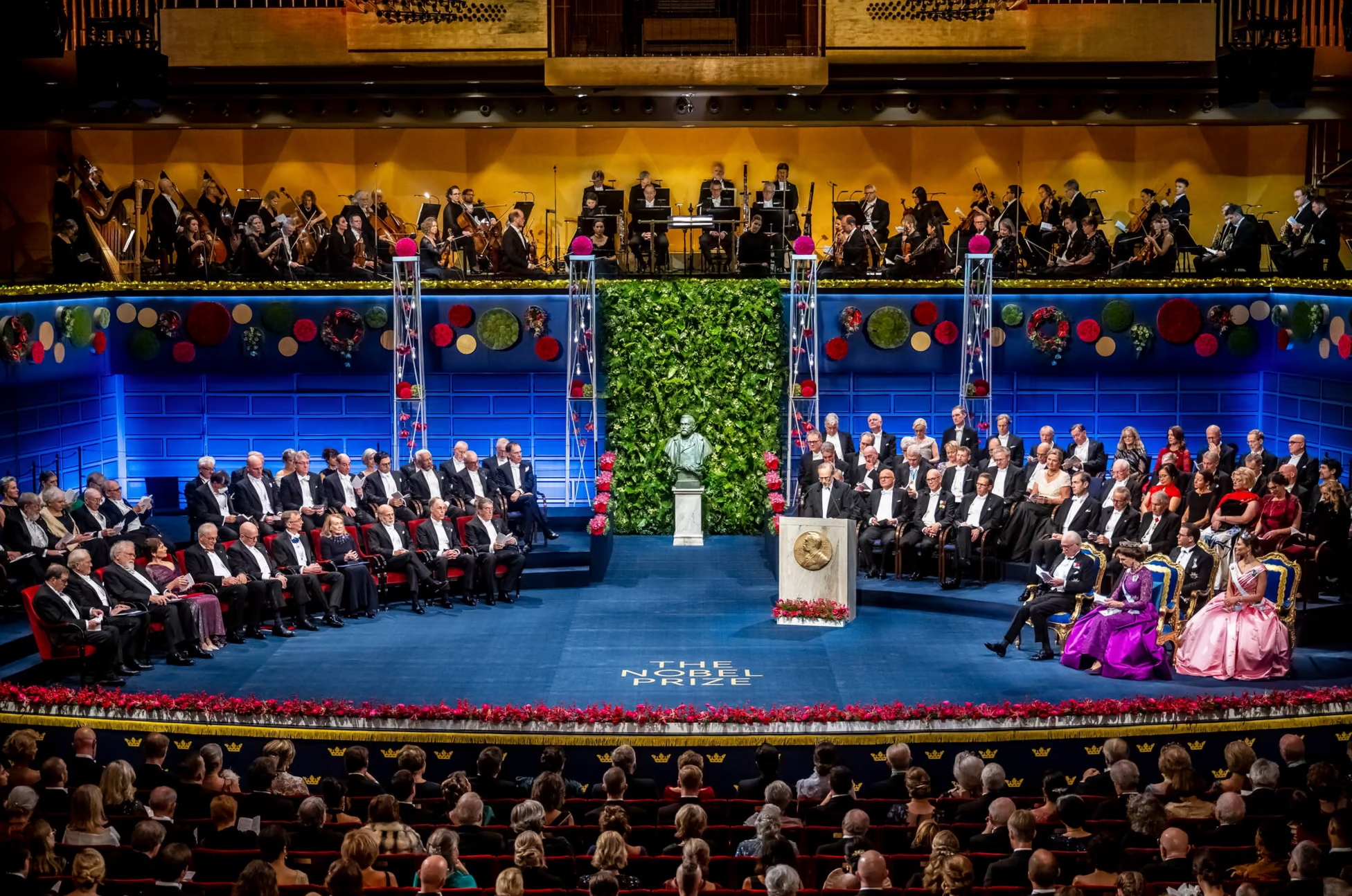
The ceremonies take place on December 10, the anniversary of Nobel’s death. The Swedish monarch presents the Stockholm prizes, while the Peace Prize ceremony is held separately in Oslo
The economics prize added later
Today, six awards are commonly grouped under the Nobel name, but Alfred Nobel established only five of them. Sweden’s central bank, Sveriges Riksbank, created the economics prize in 1968
The distinction is not merely symbolic: unlike the original five awards, the economics prize — including its monetary award and administrative costs — is funded by the central bank rather than Nobel’s endowment
The Royal Swedish Academy of Sciences selects its laureates under rules similar to those governing the original prizes, and the ceremony takes place alongside the other Stockholm awards
Why there is no prize in mathematics
Nobel’s will made no provision for mathematics. Stories attributing the omission to romantic rivalry or a personal grudge have no established historical basis
Mathematics developed its own major international awards, most prominently the Fields Medal and the Abel Prize
The Fields Medal is presented every four years and has an age limit: candidates must not have turned 40 before January 1 of the award year. The Abel Prize is awarded annually without a comparable age restriction
The Fields Medal is only a partial analogue to a Nobel Prize in mathematics
Why the Nobel name retains its status
For more than a century, the same name has been associated with Einstein, Marie Curie, Hemingway, Martin Luther King Jr., major scientific discoveries, political controversies, institutional scandals, and changing ideas about cultural achievement
Its annual schedule creates continuity across generations. The prizes span several unrelated fields, their ceremonies provide a recognizable public ritual, and decades of decisions have accumulated into a record of scientific, literary, and political history
Within individual disciplines, specialists may regard other awards as equally important or more relevant to their field. Few, however, command the same public attention
The Nobel system has endured without resolving all its contradictions. Its rules still constrain whom it can honor, its judgments remain open to historical reassessment, and its interpretation of achievement continues to evolve
Yet its public authority has survived these tensions. The Nobel name gives achievements in specialized fields a level of visibility that few other awards can match